
Understanding Strip Steel
Strip Steel Buying Guide.
Take "almost" out of the equation, with the steel solution that lets you define your own standards to optimize just about everything.
Could strip improve your manufacturing results?
Manufacturers who consume flat rolled steel may or may not be aware that a steel product exists that could exactly meet their needs. Rather than making do with the limitations of a more standardized hot or cold rolled sheet product, you could increase yields and drive manufacturing efficiencies with a steel product designed for your specific application - strip.
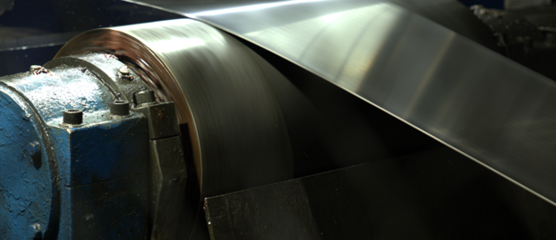
This guide will define strip, discuss manufacturing scenarios that can benefit from it, and address common misperceptions. We will also cover how Worthington Steel evaluates your steel application to match you with the solution that best meets your needs.
This article will walk you through the following:
Hot Rolled vs. Cold Rolled Steel Sheet
There are many websites, academic and supplier-based, that provide technical definitions of hot and cold rolled steel. They usually provide common application characteristics that help guide manufacturers toward the type of steel best suited for their needs.
Hot roll is suggested for applications that need strength but have noncritical surface and dimensional requirements.
Cold roll, on the other hand, is specified for applications that need any of the following:
- More precision in dimensional tolerances
- More controlled surface finish
- Stringent formability requirements
What if your needs are even more specialized?
How do you know if it's time to look beyond what hot or cold rolled sheet can offer?
You might find that your application needs don't fit neatly into commonly available specifications - whether for hot rolled or cold rolled steel sheet. Maybe you have a requirement that isn't industry-defined in either category. Or you need mechanical properties that differ from what is commonly available.
Or, perhaps, what you would ideally get is a hybrid. For example, a hot roll gauge with a cold roll gauge tolerance, or even tighter. If your needs are different from what hot or cold rolled sheet can fulfill, you could be settling for less. And, of course, if you need a customized surface, mechanical property, or chemical properties, you might be a match for a steel product called strip steel, or simply "strip", to deliver the performance you desire.
What Is Strip?
Simply, it's steel that does exactly what you need.
Strip is any flat rolled steel product with one or more specifications outside the standards offered by the steel mills. The non-standard requirement could be related to:
- Surface finish
- Gauge tolerance
- A chemistry restriction
- A hardness specification
- A unique mechanical property
- Any combination of these
To produce exactly the steel you need, Worthington Steel will utilize its extensive processing capabilities and metallurgical expertise to meet your requirements. After specialized processing, strip is typically delivered in widths narrower than 24" wide to aid in holding tighter tolerances. (*See section on comparing hot rolled sheet, cold rolled sheet, and strip).
Does Your Steel Work for You?
Common manufacturing scenarios that benefit from strip.
Meeting your stated requirements is critical to performance. But sometimes, even more opportunity for optimizing your steel lies in examining what happens in your plant. Below are a few of the most common workarounds that may warrant a strip product, but there are many more challenges Worthington Steel can solve with a strip product.
- Creating the desired surface finish: You are sanding or polishing your steel to achieve a surface finish and would like to order steel with that surface finish.
- Grinding for thickness tolerance: You are grinding your steel to attain a consistent thickness tolerance and would like to order steel with the thickness tolerance you need.
- Addressing productivity: You would like to improve your yield and minimize rework, with steel that has mechanical properties or thickness tolerance dialed in to meet your needs.
- Optimizing processes: You would like to improve your blanking process, forming process, or heat treating performance with microstructure features designed to meet your needs.
Is strip right for you?
When you look at the big picture, strip may be the most cost-effective option. If we find that strip is your best option, it will be because it saves you manufacturing costs, improves yield in your manufacturing process, minimizes rework, or increases efficiencies. (*See section on common misperceptions about strip.)
Comparisons of Strip's Properties to Hot Roll and Cold Roll
You'll find that strip steel offers tighter gauges, the broadest range for surface finishes, and the formability required to make your parts.
These are meant to be general guidelines. Some mills produce properties outside of what we list below, but those properties may not be commonly or consistently available.
| Gauge | Surface | Formability | Master Width | |
|---|---|---|---|---|
| Hot Roll* | 0.050 - 0.75" | -50-100 uin Ra (uncontrolled/ nonexposed recommended) | Bends, <3" draw; can vary for drawn and iron applications | 36" - 80" |
| Cold Roll Sheet* | 0.015 - 0.125" | -20-45 uin Ra (controlled/ up to exposed) | Bends, <8" draw; can vary for DRD or D&I applications | 36" - 72" |
| Cold Roll Strip* | 0.010 - 0.400" | -2-120 uin Ra (controlled/ defined ranges for needs) | Bends, <18" draw, can vary with D&I or DRD applciations | < -54" |
*Please note:
- All can be slit to narrow widths, commonly referred to as slit width.
- Final mechanical properties depend on grade and processing parameters; other attributes such as R-bar, delta R, hardenability, and n value can be tested for but may not be applicable depending on the application.
- Our grades web page includes more detailed information.
Common Misperceptions About Strip
1. "A strip product always means a lot of additional expense."
Not necessarily. Some specifications don't require a lot of additional processing and, therefore, don't incur significant additional cost. In fact, changing a product requirement, like surface finish, can often save you money by avoiding downstream manufacturing costs like polishing or grinding.
2. "When it comes to strip, there are standard specifications like surface finish, gauge tolerance, chemistry restriction, hardness specifications, or mechanical properties."
The only standard in strip is that you define the standards for your needs. We can follow ASTM A109 Cold Roll Strip guidelines or accommodate your custom needs.
3. "I can depend upon consistent steel properties with a hot rolled or cold rolled sheet product."
Compared to strip products, hot and cold rolled sheet products have a relatively wide tolerance. This means properties can vary quite a bit between orders and from coil to coil. Sometimes, you may get steel that happens to meet your needs, and other times, you won't. A strip product closes the tolerance gap to deliver only steel that meets your needs every time - preventing manufacturing disruptions and excess scrap.
4. "I can specify the right strip products without a full discovery process."
Just like a doctor can't diagnose you without a health history and a full understanding of your symptoms, we can't prescribe steel until we completely understand your manufacturing process and application. We never guess about steel - it is too important to your business!
5. "Strip is just a thin piece of steel or cold finished bar."
Within the steel industry, many different steel products are often classified as "strip." Pieces of narrow steel, or cold-finished bar products, are commonly called "CRS" or "cold strip." They are offered in 1.5" widths, standard lengths, and often in a 1018 grade. They are not the subject of this buying guide. We are referring to "strip" as defined by ASTM 109.
Find Exactly The Steel You Need
Now that you've been introduced to strip's potential, we encourage you to reach out and explore it with us. Worthington Steel has twenty-one metallurgists on staff to help you to determine the most cost-efficient steel product to meet your application's needs. We will present your options and help you weigh the tradeoffs between them. Of course, if a different standard product or sourcing method solves your application needs, we will point you in that direction instead.
About Worthington Steel
Since 1955, Worthington Flat Roll Steel has been delivering top-quality service that enables our customers to do the same for themselves. Our steel processing capabilities serve a variety of markets, including automotive, heavy trucks, agriculture, energy, construction, and many others.
Our commitment to our customers' business goes far beyond supplying steel. We provide advanced material support, price risk management, supply chain solutions, and the highest level of customer service and collaboration.
If you are interested in learning more about us at Worthington Steel, want to view our capabilities, or have a question that we can help you answer, please explore our website or call us at 1.800.944.3733. We are here to be partners for your manufacturing goals.
Strip Buying Guide
The steel solution that takes "almost" out of the equation.