Drivers of Steel Price Volatility
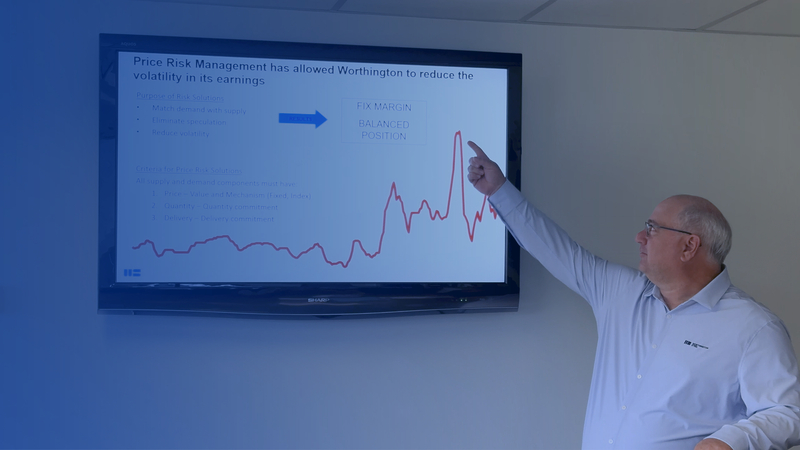
Steel pricing has historically been cyclical, but in today's market, those cycles are harder to predict and often behave differently than they did in the past. What once followed more stable, repeatable patterns is now increasingly influenced by a wider range of forces, many of which sit outside the traditional steel supply and demand equation.
This article will walk you through the following:
- Steel Pricing Still Starts with Supply and Demand, but Key Drivers Have Expanded
- The Market Has Structurally Changed
- Supply-Side Disruptions Can Move Pricing Quickly
- Demand Behavior Can Make Volatility Worse
- Managing Volatility Requires More Strategic Purchasing
- How Worthington Steel Helps Customers Navigate Volatility
- Volatility Is Not Going Away, But Risk Can Be Managed
Steel Pricing Still Starts with Supply and Demand, but Key Drivers Have Expanded
At a fundamental level, steel pricing is still heavily driven by supply and demand. When supply tightens and demand remains strong, prices typically rise. When demand slows or supply increases, prices generally fall. While those basic mechanics have not changed, the number of factors influencing them has grown significantly.
Jason Miller, Worthington Steel's Vice President of Purchasing, explains that modern steel price volatility is really about "the level of intensity" in the fluctuations. Over the last several years, the market has experienced both sharp price swings and sustained price pressure, creating a more difficult environment for suppliers and customers alike.
In some cases, prices still move dramatically over a short period of time. In others, mills may increase pricing more gradually over several weeks or months. Even when movement appears slower on the surface, uncertainty around timing and inventory strategy can still create significant risk for buyers.
Mitesh Kothari, Worthington Steel's Director of Price Risk, notes that supply, demand, lead times, and mill utilization continue to be major factors in price movements. But what has changed is how quickly outside forces can influence those fundamentals.
Trade policy, tariffs, geopolitical conflict, raw material costs, energy costs, and even weather can all affect pricing. These are no longer secondary factors. In many cases, they are primarily market drivers.
Events like wars, trade disputes, and weather disruptions are not new to society, but their impact on the steel market has grown significantly. As the global economy has become more interconnected and domestic steel production has become more consolidated, disruptions in one region can now ripple through supply chains much more quickly. Changes in energy availability, raw material flows, transportation, and international trade policy can now influence steel pricing far more quickly than they did decades ago.
Today's pricing environment is shaped by both the traditional steel market fundamentals and broader external pressures:
| Traditional Market Drivers | External / Geopolitical Drivers |
|---|---|
| Mill outages | Tariffs |
| Lead times | Trade policy |
| Inventory levels | War/Conflict |
| Scrap pricing | Energy costs |
| Mill utilization | Weather disruptions |
| Import availability | Global supply chain instability |
Kothari notes, "Anytime you have geopolitical forces affecting commodity markets, you're going to have severe volatility."
Events like COVID-19, the war in Ukraine, and ongoing trade negotiations created sudden shifts in both supply and demand. As Miller said of the pandemic, "There was no road map for that. No playbook." The market had to react quickly, and customers had to adjust along with it.
The Market Has Structurally Changed
Beyond short-term disruptions, the steel market itself looks very different from what it did 20 years ago.
There are fewer domestic mills, more consolidation, and less competition across the supply base. Miller explained that earlier in his career, steel pricing was relatively flat compared to what the industry experiences today. Over time, bankruptcies, consolidation, and shifts in global production fundamentally changed that environment.
One of the biggest influences has been the rapid expansion of foreign steel production, particularly in China. Over the last two decades, China dramatically increased its steelmaking capacity and became the world's largest steel producer by a significant margin. As global steel flows shifted, domestic pricing became increasingly sensitive to imports, trade policy, raw material demands, and broader global economic conditions.
Kothari described the earlier market as one where domestic mills aggressively competed for even small pricing advantages. Today, with fewer suppliers and more concentrated production, pricing behaves differently and reacts more sharply to disruptions.
Together, consolidation and globalization fundamentally reshaped the market. Steel pricing today is more globally influenced, more interconnected, and more sensitive to changes in supply, demand, and policy.
Supply-Side Disruptions Can Move Pricing Quickly
Marc Gase, Worthington Steel's Vice President of Price Risk and Supply Chain, points to the growing impact of supply-side constraints in today's market. Those constraints can include tighter domestic capacity, mill outages, limited import availability, and disruptions that slow material movement through the supply chain.
Mill outages, whether planned or unplanned, can quickly tighten availability. Even scheduled outages temporarily reduce supply and can create pricing pressure when inventory levels are already low, particularly for customers relying heavily on spot purchases.
Historically, imports often helped balance domestic shortages. But evolving trade policies, tariffs, freight costs, and geopolitical uncertainty have made that balancing effect less consistent. When imports slow or become less competitive, domestic mills carry a larger share of demand, allowing pricing pressure to build more rapidly.
In a tighter and more consolidated market, even relatively small disruptions can have an outsized impact on pricing momentum.
Demand Behavior Can Make Volatility Worse
While supply often gets the most attention, customer buying behavior also plays a major role in how steel pricing moves.
When mills don't have enough capacity to fulfill their order books, buyers often react by ordering more steel than they need to secure sufficient material for production. A customer who normally needs 20 tons may place an order for 40 tons, expecting to receive only part of it. In some cases, buyers may even place the same order with multiple mills at once, hoping that combined allocations will meet their actual demand.
These reactions can create what is commonly referred to as a supply chain whip. As buyers continue increasing orders to compensate for constrained supply, mills see inflated demand signals that may not reflect actual consumption. That artificial demand can tighten the market even further and increase pricing pressure.
Gase describes it directly: "Customers overbuying and double buying and triple buying is a big reason for the volatility."
The challenge comes later, when mills catch up, and customers realize they are carrying excess inventory. Ordering slows down sharply as companies work through excess material, causing demand to fall quickly and pushing pricing pressure in the opposite direction.
This is another example of how today's market volatility is not always about sudden overnight spikes. Sometimes the risk comes from prolonged uncertainty and reactive buying behavior that gradually builds pressure in the system before reversing direction.
Spot buyers are typically the most exposed to these swings. Kothari emphasizes that "spot buyers are experiencing the most volatility," especially when lead times are extended, inventory levels are low, and imports are limited.
In today's market, these types of reactions can quickly amplify price movements, making volatility harder for both mills and customers to manage. As a result, many companies are reevaluating how they purchase steel and seeking strategies to reduce exposure to sudden market shifts.
Managing Volatility Requires More Strategic Purchasing
As market unpredictability has increased, many customers are rethinking how they purchase steel. Rather than relying heavily on spot buying, companies are increasingly exploring fixed pricing programs, index-based contracts, scrap-based models, and blended purchasing strategies that provide greater stability and flexibility.
Gase said customers are "absolutely changing their thought process" and looking for mechanisms that offer more certainty. He also noted that "everybody seems to talk about the importance of managing volatility. Not everybody understands how to do it successfully."
In today's market, spot buying often carries more risk than it once did. In the past, some companies attempted to "play the market" by purchasing heavily when prices were low and relying on that inventory as prices increased. But as Miller explains, "That dynamic's changed in the last couple of years because the cycles have been so volatile."
When prices continue rising over an extended period, buyers who delay purchases may find themselves constantly chasing a higher market. At the same time, companies carrying excess inventory during a rapid downturn can face significant financial exposure. That has made purchasing strategy, inventory management, and pricing structure far more important than simply trying to time the market correctly.
Part of the challenge is that steel pricing itself is often more complex than customers realize. Pricing is influenced not only by current market sentiment but also by mill lead times, purchasing timing, contract structures, and how indexes are calculated.
For example, index-based pricing reflects transactions from the previous month rather than real-time purchases. Quarterly index-based pricing contracts smooth movement further by averaging multiple months together. Meanwhile, steel processors are often purchasing substrate from mills weeks before customers place their own orders due to mill lead times and processing requirements.
As a result, customers are frequently comparing current market sentiment against pricing tied to earlier market activity. During rapidly changing market conditions, that timing disconnect can make pricing feel inconsistent or difficult to follow.
Kothari explains that many customers mistakenly assume processors directly control pricing. In reality, pricing is heavily influenced by broader market conditions and the structure of the purchasing agreements themselves.
How Worthington Steel Helps Customers Navigate Volatility
As companies reevaluate how they purchase steel, many are looking for partners that can help them better understand risk exposure and navigate an increasingly complex market.
Worthington Steel works with customers to understand how they buy, how they sell, and where market volatility creates the greatest risk in their business. From there, teams help evaluate purchasing approaches, identify potential areas of exposure, and develop strategies that align with the customer's operational and financial goals.
A key part of that process is helping customers understand the market itself. When pricing feels unpredictable, context matters. Supply constraints, trade policy, mill outages, shifts in demand, and global events can all influence steel pricing. Understanding those drivers helps customers make more informed purchasing and inventory decisions.
Rather than focusing solely on current prices, Worthington Steel helps customers take a broader view of the market and evaluate how changing conditions may affect their business. That combination of market insight, purchasing expertise, and risk management support allows customers to make decisions with greater confidence, even in uncertain environments.
Volatility Is Not Going Away, But Risk Can Be Managed
Steel pricing is unlikely to return to the stable patterns the industry experienced decades ago. The market is more global, more consolidated, and more sensitive to external forces than it once was.
That does not mean businesses are powerless against volatility. But it does mean that traditional purchasing habits and reactive buying strategies are becoming harder to sustain.
Today, success depends less on perfectly predicting the market and more on understanding exposure, building flexibility, and creating a purchasing strategy aligned with long-term business goals.
For steel buyers, managing volatility is no longer just a purchasing challenge. It is a strategic business decision.
About Worthington Steel
Since 1955, Worthington Flat Roll Steel has been delivering top-quality service that enables our customers to do the same for themselves. Our steel processing capabilities serve a variety of markets, including automotive, heavy trucks, agriculture, energy, construction, and many others.
Our commitment to our customers' business goes far beyond supplying steel. We provide advanced material support, price risk management, supply chain solutions, and the highest level of customer service and collaboration.
If you are interested in learning more about us at Worthington Steel, want to view our capabilities, or have a question that we can help you answer, please explore our website or call us at 1.800.944.3733. We are here to be partners for your manufacturing goals.
With 70 years of experience, we have the resources to help you.